Images – Post war Rural Development in the Tonkolili District
SIERRA LEONE







Follow us on Facebook:
www.facebook.com/fiohfund
Follow us on Twitter:
twitter.com/fiohnet
Please share our links with your friends to help us reach a wider audience.
Ebola identification and prevention programme

Ebola programme
FIOH Sierra Leone carried out this programme in 2015. The FIOH Fund contributed £7,138 towards this project located in the Tonkolili, Bombali and Port Loko districts in the north of the country. Most of the funding came from Bread for the World.
Where does Ebola come from?
The first known incidents of the Ebola virus were in 1976. There were two simultaneous outbreaks in Nzara in Sudan and Yambuku in Zaire (now the Democratic Republic of Congo). The name of the Ebola river near Yambuku was given to the new epidemic.
Outbreaks have mainly occured in remote villages in Central and West Africa, close to tropical rainforests.
The main outbreaks were in West Africa, mainly in Guinea, Sierra Leone and Liberia.
Ebola is described by the World Health Organisation (WHO) as “one of the most virulent viral diseases known to humankind.”
There are five distinct species of Ebola and the survival rate ranges from 25 to 90%. There is no licensed vaccine for Ebola although several are currently being tested.
How is the Ebola virus transmitted?
- Ebola is passed to humans through close contact with the blood or bodily fluids of infected animals. Fruit bats, monkeys and chimpanzees can all carry the virus.
- Ebola then spreads through human-to-human transmission, again from contact with blood or bodily fluids.
- Burial ceremonies where mourners touch the body of the dead person can also spread the disease.
- The incubation period (the time from infection to the onset of symptoms) is between two to 21 days.
- People remain infectious as long as their blood and secretions contain the virus.
What are the symptoms?
Initial symptoms include the sudden onset of a high fever, muscle pain, general weakness, headache and sore throat.
Further symptoms include vomiting, diarrhoea, rashes, damage to the kidney and liver function.
In some cases symptoms can include both internal and external bleeding.
There is no known cure or vaccine for ebola.
How can the virus be prevented?
- Routinely cleaning and disinfecting farms to inactivate the virus.
- Animals should be handled with gloves and protective clothing. Meat should be thoroughly cooked before eating.
- If an outbreak is suspected in animals, the premises should be quarantined and infected animals culled.
- Avoiding physical contact with people infected with Ebola and protective clothing must be worn.
- Washing hands after visiting patients in hospital, or after taking care of those infected at home.
- Inform the authorities when a community is affected so containment measures can be taken.
- Ebola victims should be buried quickly and safely, with no direct contact with the corpse.
What is being done to treat it?
Several vaccines are being tested, but none have been approved for clinical use.
Severely ill patients require intensive supportive care. Patients are frequently dehydrated and require oral rehydration with solutions containing electrolytes or intravenous fluids.
Background to the project and problem analysis
 In May 2014 the Mano River Union countries (Sierra Leone, Liberia and Guinea) experienced an outbreak of ebola. Between May and October 2014 the disease left over 4000 people dead in this part of West Africa. In Sierra Leone the epidemic spread across the length and breadth of the country.
Since the outbreak the Future In Our Hands – Sierra Leone together with Youth with Focus, Kankalay Youth Development, Sorbeh Nyagah Women’s Association and God is God Ministries were part of the national Sensitization Team engaged in Community Education on the Prevention and spread of the Ebola Virus. Our messages focused on the causes, symptoms, preventive measures and required action in the case of infection. Although we were fairly satisfied that most communities were fully aware about the outbreak and the infectious nature of the disease, we realised the need to take the fight to another level as the spread of the disease was not then contained. We realised that the strategy then adopted was mainly focused on providing supportive treatment for infected patients at specially established treatment centres in Kenema and Kailahun; then scaled up to Freetown. Initially the follow-up of contacts was difficult due to mistrust and resistance of the local communities; attributing the infection to witchcraft, failing to take sick patients to hospitals and resisting attempts to collect dead bodies by the authorized burial teams for sanitary burials. These challenges led to a failure to effectively interrupt the chain of infection. The situation was aggravated by the very weak capacity of local health facilities as they were not able to adequately mount a consistent response due to ill preparedness and loss of staff frightened by the high morbidity among their ranks. This utter state of paucity weakened the overall health system even further. Communities were not equipped to isolate suspected cases effectively. This led to an increase in stigma, discrimination and fear. This awareness among FIOH-SL ignited an action to build community capacity to respond to the ebola epidemic by forging stronger partnership and collaboration with state actors and non-state actors.
The death of many health care workers in the country created panic and mistrust in hospitals, with reports that some health care workers were abandoning their posts. Ebola is almost universally fatal. Victims were socially stigmatized and isolation represented an offense and family shame.
Some of those affected by the virus were either abandoned or rejected by their families during hospitalization. In the isolation ward in particular, the most harrowing experience for victims and health workers was the loss of friends and colleagues who died next to them. The reluctance of hospital personnel to treat them and the abandonment by medical staff including the refusal to admit visitors was also difficult to bear for most patients. The grief for family members who did not survive was also very intense. Some of those who survived either tried to escape from their families or immediate neighbourhoods for fear of stigmatization. Those who survived, even though completely healthy, were feared by others. People did not want to come near them or have anything to do with them. Even their children were told not to touch them and wives were told to go back to their home villages and communities. The discrimination extended to family members and friends, who were regularly shunned at market places and other public areas. For the community, the psychological trauma of losing loved ones and witnessing death on a large scale and ebola burial methods were very distressing and traumatic and often caused severe long term mental health consequences for the relatives of the victims.
Prior to the outbreak of the ebola virus in the country, Sierra Leoneans were much concerned about family members’ sicknesses, deaths and other social issues. In most cases the families even raised funds to bury their dead with the full participation of community members whether the community was heterogeneous or homogeneous. The community members also provided peer support for those with serious illnesses or for bereaved family members. But with the collapse of this unique practice due to the ebola virus outbreak in the country, there were very serious family divisions and animosities. For instance, family members could not touch their loved ones in the event of sickness or death, while members of the community.
The FIOH Sierra Leone forum saw the need to promote peace among families, in the communities and in the nation as a whole. The forum aimed to provide psychosocial support to survivors, family members and volunteers, including social workers and clinicians. Volunteers, mainly community leaders, social workers and family members, were trained to conduct community sessions/outreach campaigns for the mitigation and reduction of stigma and fear of ebola survivors and their families in the communities.
Objectives
Overall Objective:
- Eradicate Ebola Virus Disease (EVD) from communities by April, 2015
- Increased respect for human right of EVD infected person by April, 2015
Specific Objectives:
- Increased community awareness to prevent ebola
- Strengthened community health services able to prevent ebola transmission
- Increased protection of ebola susceptible person
- Improved environmental sanitation and personal hygiene
- Re-integrate affected communities
Coordinate and monitor project implementation.
Project activities
- Increased community awareness to prevent ebola
- Volunteers ans staff trained on ebola prevention and contact tracing
- House-to-house visits carried out to identify sick persons for referral to health facilities.
- Reports made to district Ebola Operation Center (EOC) of all suspect persons or death and samples collected for ebola test.
- Flash electronic thermometers distributed.
- Health workers trained in Universal precaution and use of PPE.
- Community volunteers trained to work with burial teams.
- Infected persons transported to holding centers.
- Relief items including blankets, food, and water distributed to holding centre.
- Dead bodies collected from communities for sanitary disposal.
- Family members trained on hand washing and waste disposal methods.
- Ebola confirmed premises disinfected.
- 30 hand pump water wells constructed.
- 30 hand pump water wells rehabilitated.
- 600 ventilated pit latrines constructed.
- Agricultural packages (seeds & tools) distributed to 100 farm family heads.
The table below summarises the situation in the three regions in mid 2015:


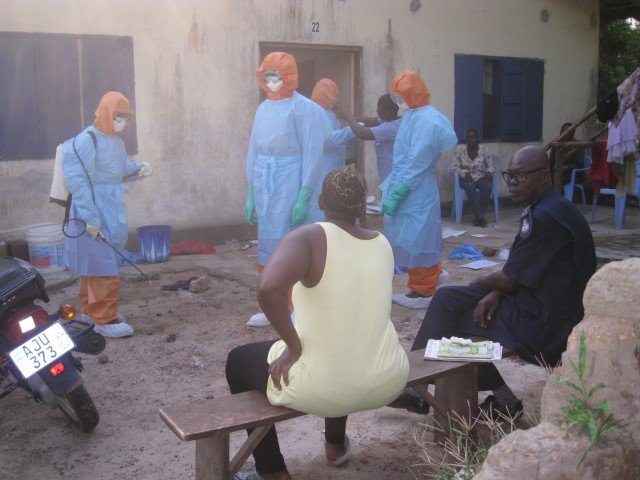

Protective measures. Training. Safe burials.
If you would like to support the work of the FIOH Fund please make a DONATION:
Follow us on Facebook:
www.facebook.com/fiohfund
Follow us on Twitter:
twitter.com/fiohnet
Please share our links with your friends to help us reach a wider audience.
School building and education in Yonibana, Tonkolili District
 Background and problem analysis
Before the advent of the 11 years long civil conflict in Sierra Leone, education was regarded as one of the corner stones of socio-economic development of the country. During this era, the country used to be called the ‘antens of West Africa’ where people along the West African coast came to acquire quality education.
But this situation changed during and after the war when the country experienced massive destruction of the social and educational structures which in turn made its citizens vulnerable and jeopardised the future of children thereby denying their protection right which is education. This has also been compounded by the outbreak of the Ebola Virus disease which denied effective schooling for children during 2014 and most of 2015.
The Rosari Benthee, Fouthernefor, Mayolah, Mayebo and Magbanapoli communities are found in these remote parts of Kunke chiefdom in the Tonkolili District where children trek over four miles to access educational facilities in chiefdom headquarter town (Masingbe) and the neighbouring chiefdoms.
During the rains children reached the schools with their uniform and books soaked and most times returned home without learning.
In addition, most children had to go across streams from their different villages and during the peak of the rainy seasons most streams became over-flooded stopping the children from reaching the school.
Through community initiative and support, in 2008 a three classroom building was constructed with mud and roofed with thatch but leaked profusely during heavy rains. This coupled with poor sanitary conditions (no water well and toilets facilities) made these children prone to health hazards.
This school, with a population of 110 pupils, was supported by community voluntary teachers with limited sitting accommodation, teaching and learning materials hence making learning difficult for these children in classes 1, 2 & 3.
However, this classroom building could not accommodate the increased population of children. With the growth of the school to classes 4,5 & 6, there was a need to provide basic educational facilities for these disadvantaged children as the facilities used were not educationally productive.
It is against this backdrop the Rosarr Primary Education project was designed to provide a conducive learning environment for 200 children drawn from five village communities in the Kunike Chiefdom in the Tonkolili District.
Objectives
- To construct a 3-classroom building with a staff room and store
- To construct a hand pump water well in the school compound
- To construct a 4-apartment VIP toilet
- To furnish building with desks, benches, chairs, chalk, exercise books, pens, pencils and rulers.
This project is one of several school building projects partly funded by the FIOH Fund. During 2014/15 the FIOH Fund provided grants of £5,040 for a school building programme in the district with the generous support of Georg Hansen from Norway.


If you would like to support the work of the FIOH Fund please make a DONATION:
Follow us on Facebook:
www.facebook.com/fiohfund
Follow us on Twitter:
twitter.com/fiohnet
Please share our links with your friends to help us reach a wider audience.
Future in Our Hands Sierra Leone
 Future in Our Hands Sierra Leone
Background
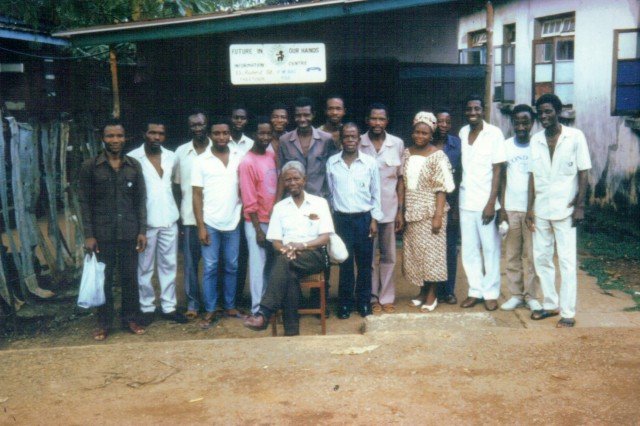 An FIOH group was established by Olatunde Johnson in Freetown in the 1980s and registered as a national non-government organisation by Edward Kargbo in 1995. The first interest in FIOH arose from an article in the New Internationalist and the second from a seminar at Port Loko when Mike Thomas paid a second visit to the country in 1993. Edward, who attended the seminar, formed an association of 13 farmers groups which was then named the FIOH Farmers Union. The name was later changed to FIOH Sierra Leone.
Edward Kargbo testimony: EDWARD TESTIMONY
Mission Statement
The Mission of FIOH Sierra Leone is to co-ordinate and facilitate the efforts of village development groups by enabling them to access farming inputs, modern farming techniques, education and skills poverty alleviation programmes, sanitation and credit facilities for self-sustainability and self reliance.
Programme interventions – capacity building, food security, women and youth empowerment, environment, health and sanitation, advocacy.
Brief History Of The Organisation:
 The Future In Our Hands Sierra Leone (FIOH-SL) is an indigenous non-governmental organization with a Head Office in Makeni (Bombali district) and sub-offices in Kabala town (Koinadugu District) and Mile 91 (Tonkolili District). It was established in 1993 as an offshoot of what was formally the Yoni Farmers’ Union. In 1994, as the situation in Sierra Leone deteriorated, the membership decided that FIOH had a vital role to play in providing assistance to those affected by the escalating conflict. The main focus of the organization during the rebel war was to complement the emergency and relief work of the Government of Sierra Leone, as well as that of international and national NGOs.

During and immediately after the war, FIOH worked in collaboration with CARE International, Department for International Development (DFID) UK, Voluntary Service Overseas (VSO) UK and the World Food Programme (WFP) UN, distributing food and other relief items to internally displaced persons in their operational areas. Further activities included providing psychosocial support to affected communities and raising awareness on human rights, HIV and AIDS prevention and control.

Edward Kargbo and his family surviving in the bush
Youth group in Freetown
Displaced people queuing for food at Mile 91
FIOH vocational training centre at Mile 91
Following the end of the conflict in 2002, FIOH shifted its focus from emergency relief to development which involved building the capacity of communities for self reliance. It has continued to build partnerships and linkages with a variety of local and international organizations and has implemented two projects (Conservation Agriculture Project (CAP) and Villages Savings and Loans (VS&L) project with CARE-SL in Koinadugu District whilst the Voluntary Services Overseas (VSO) has provided the human resource support. In addition, the FIOH Fund-UK and UN/WFP supported Life Skills Trainings and Community Asset Creation for marginalized youths and communities.
FIOH-SL also enjoys strong links with community based organisations (CBOs) at grassroots level aimed at building their capacities to better serve their communities.
Food for work
 During 2003 FIOH Sierra Leone was able to increase its operational area to include 3 chiefdoms (Kissy Tongi, Njaluahun and Dea) in the Kailahun District and two chiefdoms (Kalansogoia and Sambaia Benduga) in the Tonkolili District.
In August 2012, FIOH Norway member, Nini Haeggernes, visited Sierra Leone and was made aware of the work of Edward Kargbo by Mike Thomas. Subsequent to her visit she wrote an article which appeared in the FIOH Norway magazine, Folkevette: FOLKEVETT-FIOH SIERRA LEONE
Norwegian, Georg Hansen, read this article and decided to visit the country and see the the work of FIOH Sierra Leone. He has raised a considerable sum of money to support a school building programme and has contributed funds to address the ebola crisis in 2015.
 Future in Our Hands Sierra Leone
37 Lunsar Road
Makeni City
Northern Region
Sierra Leone
Post war rural development in the Tonkolili District

Post war Rural Development
This project was intended to help people living in the rural areas of the Tonkolili District recover from a 10 year civil conflict.
The project was officially launched in November 1998 and comprised agriculture and small-scale income-generating activities. Maize, pepper, cassava, cow pea and egg plant were grown successfully.
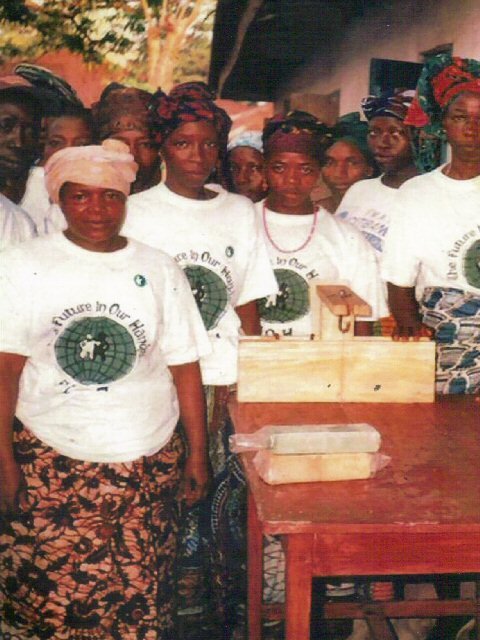
Gara dyeing, tailoring, soap making, bread making, including the required training, were established in conjunction with savings and credit schemes. All of these activities proved to be sustainable in the long term despite being interrupted by a resumption of hostilities between February and December 1999.
The background to the war and an account of the monitoring visits Mike Thomas made to Sierra Leone can be seen here:
BACKGROUND TO THE WAR IN SIERRA LEONE
SIERRA LEONE DIARY 2000 and 2002
The project was re-launched on 26th February 2000.

Mike Thomas and Edward Kargbo at Mamyoko heliport
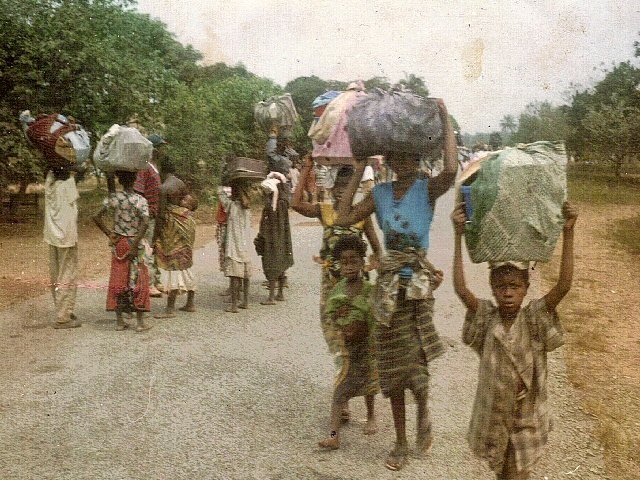
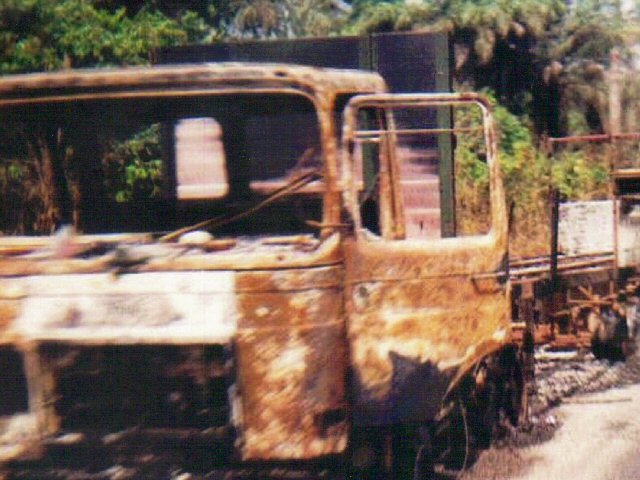
Mike Thomas made a monitoring visit on 5th May 2000, but had to leave the country two days later because of renewed rebel activities. Shortly after about 45,000 people fled into the project area due to fighting between rebel and government forces. In addition to the intended beneficiaries, emergency food and water was provided to many of these internally displaced people.
The pictures above show (i) the effects of a rebel attack on a relief convoly, (ii) Displaced people queuing for food, (iii) displaced people fleeing from rebel attacks (iv) displaced people with their belongings, (v) one of 10 Swindon schools which collected she boxes of emergency aid to send to Sierra Leone (vi) the aid being distributed at Yonibana.
Rebels first attacked the project area in December 1994 destroying two villages and most public buildings and shops . Many of project beneficiaries shown had been traumatised by rebel attacks and seen members of their families killed and maimed. Many spent months surviving in the bush. Many will have spent time in Freetown slums or displaced camps where they have had to develop new skills to survive.
The project co-ordinator, Edward Kargbo, himself a farmer, had to adapt to these very different environments and at one stage spent nine months surviving in the bush with his large family. Several of his staff were killed and others brutally maimed.
One of the most successful activities of the project during periods of conflict was the seed multiplication programme. This involved sowing crop seeds in areas not affected by rebel activities and using some of the seeds derived from those crops in other areas when vacated by rebels.
When peace was eventually restored after the intervention of British troops and United Nations troops from India and Pakistan, Mike Thomas carried out the final monitoring visit between the 18th November and 7th December 2002.
All agricultural activities had been re-established and the training centre had been rebuilt after it was destroyed by rebels. Most of the tools and equipment had been hidden during rebel attacks and were re-claimed.
The partner non-government organisation, Future in Our Hands Sierra Leone is now well known and respected for its development work in the region.
If you would like to support the work of the FIOH Fund please make a DONATION:


Community centre and water supply in Kroobay slum, Freetown
 Community centre and water supplies in Kroobay, Freetown
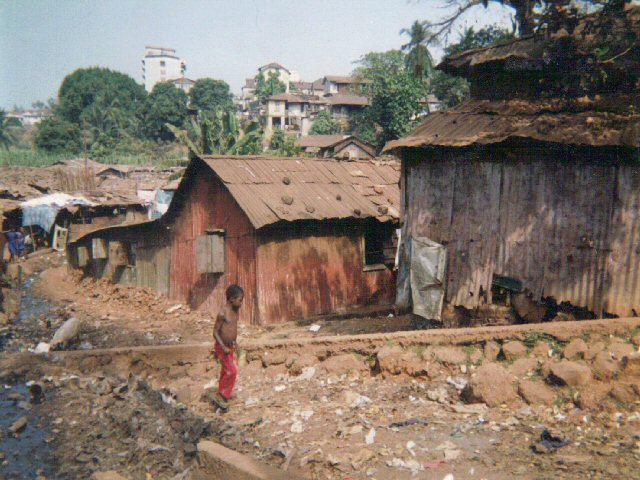

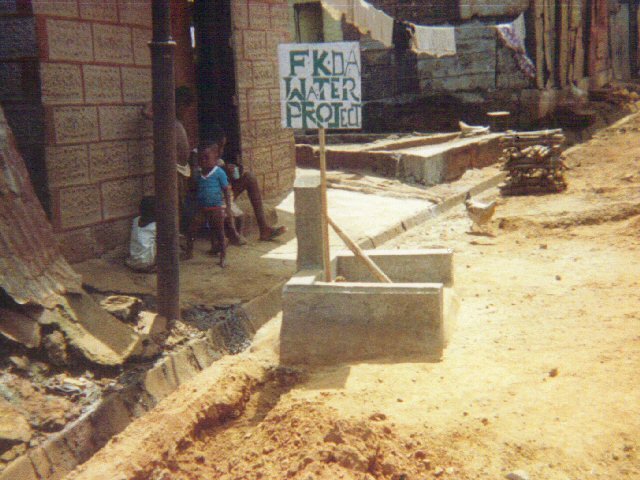 In 1992 the FIOH Fund supported the installation of three water supplies to a slum community of 5,000 people situated by the sea in the capital of Sierra Leone. The health situation was extremely bad. Homes were very basic and three sewage outfalls from the city flowed through the area which was also prone to severe flooding during heavy storms.
In this video one of the tribal chiefs explains some of the problems the community experience. The Kroobay football team reaches the final of the local tournament:
In 1993 the FIOH Fund provided funds to start work on a community centre at Kroobay.
The walls were completed in 1999 but work then stopped during fighting between Nigerian soldiers and rebels who occupied the city. The building was completed in 2002 with support from the World Health Organisation.

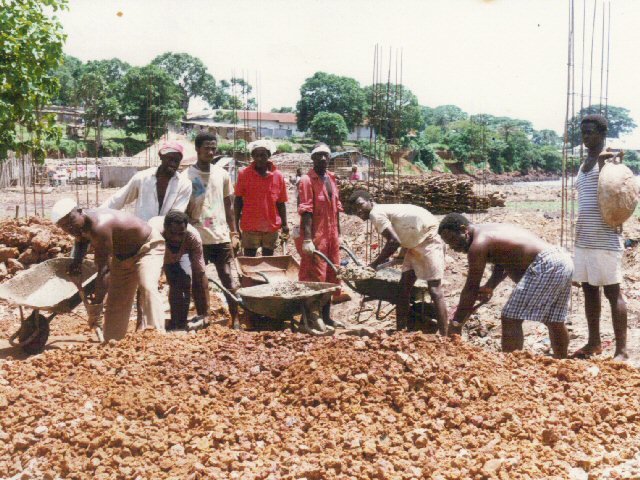
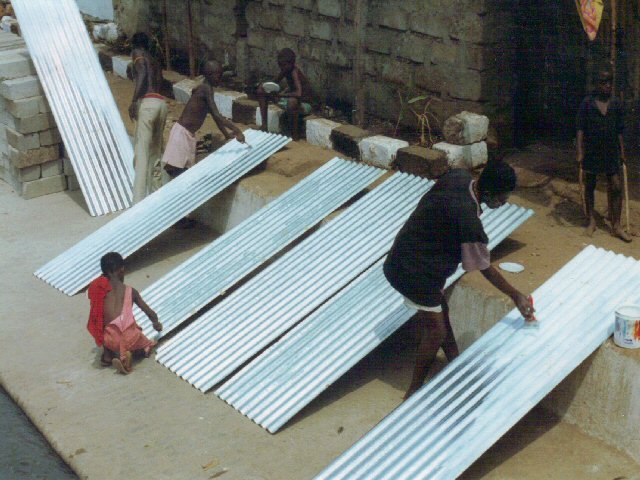

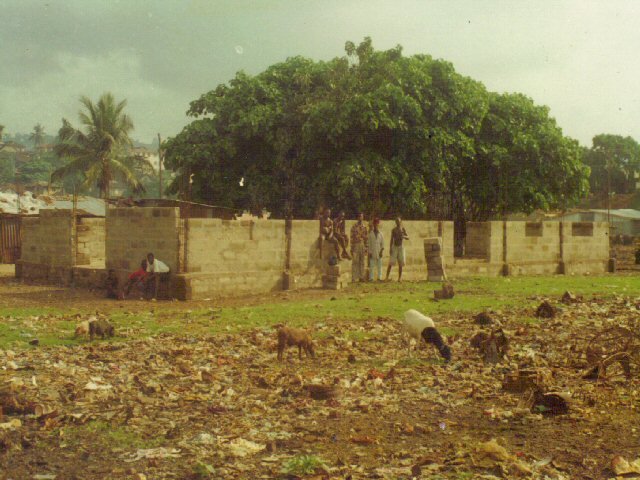
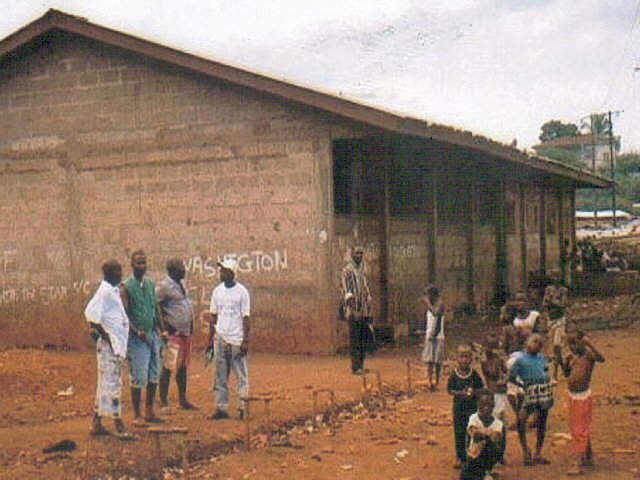
The building is now being used as both a health centre and social community centre.
Health conditions have improved but the population of the slum has increased.
If you would like to support the work of the FIOH Fund please make a DONATION: