
Future in Our Hands Kenya activities 2016
FIOH-KENYA REPORT – 2016
- WOMEN CREDIT UNION: The women have been going on well with their loaning program. The money received from Ebay boosted their kitty very well. The capacity building workshop held for the women groups has really motivated them and the results can be seen from their return reports.
- THE YOUTH GROUP: The poultry project by Usoma Shiners youth group is still stable. The group now has 500 hens . This project was co–funded through FIOH-USA in 2013. The group plans to venture into fish farming by putting up a fish pond along Lake Victoria so as to preserve the rare species that are facing extinction due to use of poor fishing methods.
- THE COW PROJECT: This is known as the Poor Man’s Bank Initiative whereby we fund women groups to purchase dairy cows that they can easily manage and take care of. They are taught to use the wastes from the cow to practice organic farming in their gardens so as to help in nutrition. The little money they get from sale of milk is used for subsistence. So far, two groups have been funded and we have proposal for 4 more groups.
- WELLS: The latest well in Wathorego Kibos is complete and is serving the residents well. All the other wells are in good working condition. The well was donated by a volunteer from USA at a cost of $3000. It serves approximately 300 households in this village with an average of 6 people per household. FIOH- K has identified 3 more villages that are in dire need of water i.e Mawego village, Seme Village and Alego. Both Geological and hydrological surveys have been carried out . We are looking for sponsors or donors to fund these projects. The wells that have been dug through donation from FIOH-USA have reached 20 in number.
5.TREE NURSERY: Due to the effect of global warming,
deforestation is rate is alarming. We have started a campaign
for reforestation in Kisumu County .We envisage to start tree
seedling nurseries in each of the 7 sub counties of Kisumu in
order to create awareness on importance of trees. It has not
rained since May. Even the long rains of April and May which
is normally used for planting season failed that people are
facing starvation. A proposal for this too is ready and has been
sent several organizations with no response yet.We are looking
for partners towards this endeavour.
- COMMUNITY LIBRARY AND RESOURCE CENTER:
It was Rom’s wish and dream to have a community Library
and resource center in Usoma village where he taught for his
entire teaching career. This he said would stump out illiteracy
and create awareness among the vulnerable people in the
village. Land has been donated for this, and a proposal ready
for the same. We haven’t submitted the proposal to any
organization.
Our main partner is still FIOH-USA which primarily funds the
orphans education program and HIV and AIDS program.
Their resources are limited as they too depend on donors.
We are very much in contact with Sr.Linda and she visited for
2 months this year with another volunteer.
Paul Odhiambo, Co-ordinator.


Follow us on Facebook:
www.facebook.com/fiohfund
Follow us on Twitter:
twitter.com/fiohnet
Please share our links with your friends to help us reach a wider audience.
Beneficiaries of the Poverty Alleviation in the Thar Desert project
Typical case histories of three people who benefited from the Poverty Alleviation Project in the Thar Desert, Pakistan managed by the Participatory Village Development Programme:
Radha
 My name is Radha. I was selected as one of the beneficiaries of the FIOH PROJECT and I was given project management and handicraft skills trainings by PVDP and 25 fodder trees, 25 bair trees, one water tank, fuel efficient smokeless stove and a loan for handicraft making. I had never in my dream thought this kind of packaged support for reducing our poverty and vulnerability. Not only that my one son and one daughter were admitted in PVDP supported primary school but I also got the chance to learn to read, write and count up to 100 in adult literacy centre that was established by PVDP in our village.
I was one of the members of the Village Development Organisation and took an active part in the meetings and trainings to improve my knowledge and skills which gave me a lot of confidence to make decisions about my life and my children. I felt that I am terribly saved from falling into the trap of my in-laws who would never have given my children the opportunity to go to school. Also they would never had allowed me to join the adult literacy centre, attend community meetings and workshops which opened up my eyes and mind and gave me so much confidence to spend my life peacefully as a free human being.
I really feel that I have come to new life. The loss of my husband has been made good through PVDP support. Today, I am happy that despite serious droughts over last year, I am looking forward to getting some income from the sale of bair fruits in one or two years from the 50% of the trees which I have saved during the drought. I also managed to save 50% of the fodder trees on which my livestock will survive in the future years. I am already getting some income from the sale of embroidery work. I store my water in the tank which saves my time of fetching water from a distant well. The time I save is spent in doing embroidery work, attending community meetings and training workshops. I am also happy with my fuel efficient smokeless stove. When I used the traditional stove, I often used to have sore eyes due to smoke emission. With this smokeless stove I feel very comfortable, my eyes are protected, the stove uses less wood and cooks faster due to two burners. With so much of support from PVDP our family’s life has really changed.
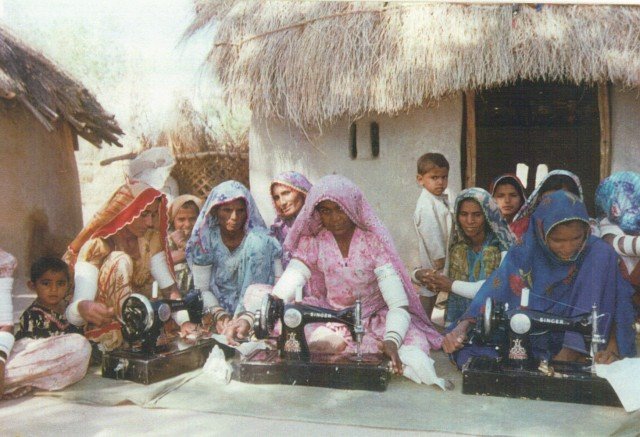
I went to PVDP established vocational center in my village and learned to make purses and sewing clothes on sewing machines provided by PVDP. After the training I am happy that I can sew cloth and can earn money from this skill. I can also make purses which PVDP is trying to find market for. I am hopeful that when purses will sell and I can tailor make clothes for other people and earn handsome money which will help to reduce our poverty. I have become alive again! Thanks to PVDP and the FIOH Project.
——————————————————————–
Indra
 I am Indra. I have entered in the fourth year of this project which is helping to improve my family’s socio economic position. Now I am the active member of my village organization and active member of PVDP. I attended all trainings conducted by PVDP and also attended all programmes organized in our village by our Village Development Committee. Now I have the skills and confidence to give presentation of our community development work to our village people and outside visitors. I was also made aware of the important role of mother in looking after the children and their schooling. Now I take good care of all my children.
I also send my children to school and at home I make them study. I also help them where I can in their studies. I am supporting my community to becoming literate. Adult literacy classes are conducted in which I teach women to read, write and acquire numerical skills. The trainings and seminars I have attended have helped me in becoming aware of community issues which need our action to address them. I also realized that 8th class is not enough for me so I got admission for further studies. I now study at home and go to city to appear in exam. I am hoping to complete my matric over the next two years. I have a government job in which I am working as community health worker. I am helping women in their pregnancies and safe deliveries. PVDP health team regularly update my knowledge and skills about health care. I am very thankful to PVDP and the FIOH Fund that through their support my own and family’s life has changed.
——————————————————————-
Welayt
 I am Welayt. I have entered in the fourth year of this project which is helping to improve my family’s socio economic position. Despite my disability I feel more at ease and involved in various opportunities created by this project. After becoming a member of VDO for four years of this project, I have attended different training programmes and sessions such as handicraft training, livestock management training, and wild food preservation. I can now take care of my livestock and this year we preserved different vegetables which helped to somewhat secure our foods.
My mother and me make embroidery work which get sold in the local market and we earn some income from this activity. It is particularly helpful during drought times when most of our resources deplete. It is my wish that our daughters go to school to get education at least up to primary level to learn some basics of education that could help them in their future life.
We are strictly bound to comply with the set of rules of this culture. The changing of culture is not as easy as changing habits; it needs self persuasion and discipline. Earlier, women in my village were not allowed to attend meetings and trainings. My husband, after attending various trainings of PVDP on civil & political rights, project management, and livestock management etc. inspiringly, motivated to his community to provide same opportunity to their females for becoming active member of VDOs. But no one was agreeing for this change. PVDP in that situation organized more meetings and trainings to convince our community for female participation. Then, PVDP selected 16 households as beneficiary of FIOH Fund UK Project. We were provided with water tanks, bair trees, fodder trees, fuel stoves, and embroidery support loan with informative trainings. We hope to have more income in future through sale of bair fruits and handicraft work.
I am thankful to PVDP for providing embroidery skills to me and my daughters who cannot be educated due to our rigid culture, but they learned skills to earn at home. Another good thing happened is that my daughters can write their name and know counting of numbers by attending classes in Adult Literacy Centre of PVDP.
——————————————————————————

Follow us on Facebook:
www.facebook.com/fiohfund
Follow us on Twitter:
twitter.com/fiohnet
Please share our links with your friends to help us reach a wider audience.
Future in Our Hands Pakistan
Background
 FIOH Pakistan is part of the FIOH International Network. It was established in 2005 as a non-profit civil society organization in Pakistan having national coverage. Provincial offices will be located in all four Provinces of Pakistan at an appropriate time.
FIOH Pakistan has adopted the Principles of the FIOH Movement.
Aims and objectives
- To advance public awareness that development is a matter of right rather than charity.
- To propagate the removal of hunger as a means of establishing peace and tranquility among human beings.
- To develop the capacities of people to honorably and boldly cope with their situation and work towards the establishment of peace.
- To work towards Inter-Faith harmony between all people.
- To promote environmental education for creating conditions for the greening of Pakistan and establishing environmental peace.
- To promote a simple lifestyle by the more affluent people in society so that savings can be invested in social welfare of the poor.
- To campaign for changes in the unjust social, economic and political systems and cultural attitudes which oppress or impoverish people, especially women and children.
- To pursue the principles of the FIOH Movement through the services of an Information Centre and by fostering and co-coordinating the growth of local community groups.
- To work in co-operation with like-minded organizations nationally and globally for the promotion of peace, tolerance, justice and equality of all human beings.
- To develop networking with National and International Civil Society Organizations.
- To disseminate information to all stakeholders including Government and Non-Government Organizations promoting the objectives and principles of FIOH Pakistan.
Help for victims of the earthquake in 2005


FIOH Pakistan, with limited financial resources, collected blankets and clothing to distribute to the victims of the earthquake that occured on 8th October 2005. At the beginning of November 2005 the death toll was estimated at over 73,000.
With a small grant from the FIOH Fund UK, FIOH Pakistan carried out a survey and feasibility study in the area affected with a view to providing longer term help to the victims in 3 or 4 villages by supplying goats, tree and vegetable seeds.
St Joseph’s Grammer School in Karachi helped with emergency supplies.
FIOH Pakistan is working with the Participatory Village Development Programme (PVDP) and has no separate office yet nor staff. It works on a voluntary basis. The activities conducted in 2009 and 2010 included:
- Youth rallies for human rights and environment protection in Pakistan.
- Awareness on the importance of National Identity Cards for government services and security.
- Health and hygiene awareness among youth, women, girls, boys and minority communities.
- Relief Operation in which food and non food items provided to flood affected men, women, children and minority communities in Sindh.
- Formation of Youth Groups and capacity building for advocacy on human right.
- Awareness on the importance of education for social development of poor communities.
- Interactive Theatre used as a mobilization tool for creating awareness.
Pakistan experienced a series of disasters in 2010.
A massive flood engulfed half of Pakistan destroying life and properties all over the country. More than 20 million people were affected, exceeding the combined total of people affected by the 2004 Indian Ocean Tsunami, the 2005 Kashmir earthquake and the 2010 Haiti earthquake. In funding terms, the revised inter-agency appeal disaster (US$ 2 billion) issued on 17 September was the largest ever, surpassing even that for the Haiti earthquake earlier this year with over 10 million children hit by the flooding.
World Environment Day was celebrated on 5 June at Hyderabad District by FIOH Pakistan jointly with the Environment Protection Agency and partner organization Participatory Village Development Programme (PVDP). The purpose of celebrating the event was to undertake initiatives to mobilize communities to take environment friendly initiatives and reduce environment polluting activities. Mr. Dominic Stephen and Mr. Irfan Abbassi were the main speakers after the rally conducted at the Hyderabad Press Club. Speaking on the occasion Mr. Dominic said that it is the responsibility of both the government and the common man to take initiatives to keep the environment clean, otherwise we will have to encounter horrible consequences in future. Mr. Irfan Abbassi official of EPA said the government is making efforts to ensure a clean environment for the public safety. He maintained that local Government is ready to work with the civil society organizations on any environment issue.
In addition to this a theatre performance was presented to the audience at the conclusion of the walk at the Press Club. A theatre team highlighted the common environmental problem caused by carelessness or lack of awareness of the people. They brought it to light that plastic bags are a big problem and cause blockages in sewerage systems which creates health and sanitation problems. They asked the audience to use cloth bags instead of plastic bags for shopping.
To sensitize the community of Thar Desert about the importance of National Identity Cards FIOH and PVDP organized 5 awareness meetings in many villages of the Thar Desert. In these meetings it decided that PVDP’s Khushal Goth Markaz Committees (KGMC) will prepare the list of those adult men and women who have no Computerized National Identity Cards (CNICs) due to various reasons.
PVDP organized 5 Health and Higeine Awareness Workshops in 3 schools and 2 villages of taluka Nagarparkar, District Tharparkar jointly with FIOH. 90 school children and 80 adults including women and youth of the villages attended the workshops. In these workshops people were sensitized about the following health and hygiene interventions.
· Care of teeth and trimming of finger nails.
· Body cleaning/bathing
· Wearing of clean clothes
· Hand washing after defecation/anal cleaning after defecation.
· House and kitchen and cooking pots cleaning
· Cleaning of village
· Clean drinking water/filtration of drinking water.
Youth rally for human rights
A remarkable Youth Rally was organized to sensitize the youth about human and social rights at Ratanabad, Mirpurkhas, Sindh. Mr. Dominic was the speaker in the Rally and highlighted some of the main human and social rights violations taking place in Pakistan. 57 persons, including youth and people from different walks of life, attended the Rally.
Formation of youth groups
FIOH Pakistan formed three youth groups in 2010. FIOH orientated and trained them for human rights advocacy. These groups were formed in Tando Allahyar, Ratanabad and Mirpurkhas Sindh and these groups are active in their areas.
Education for social development of poor communities
Lack of education is one of the main reasons for poverty and this has created obstacles in the way of community development of poor people in Pakistan. Most of the adults, particularly women, are illiterate and are unaware of modern tools and techniques that could enhance their quality of life and standard of living. Very few women are literate and this puts them at the bottom of the social ladder due to the cultural mindset and traditional norms. Due to lack of literacy and awareness the women are considered to be the weakest members of the family.
FIOH Pakistan believes that if adult members of the households are literate and educated, they can contribute towards the formation of an exemplary society in the country which can enable them to cope with their socio economic barriers. FIOH and PVDP therefore, organized 4 seminars to make the people recognize the value and importance of education.
Interactive theatre
As the theatre is one of the best tools to convey the message to communities especially to the youth FIOH Pakistan arranged 5 theatre performances during the year to mobilize and sensitize communities about different aspects of life including environment, human rights, literacy and health.
Response to the flooding
FIOH provided food and non-food items to flood affected men, women, children and minority communities in Sindh.
According to UN sources, 20 million were affected all over Pakistan. About a million houses were submerged. Huge damage was caused to schools, health facilities, community centres, roads and other infrastructure. 40% of livestock and all crops were lost in flooded areas. About 2000 flood related deaths were reported. There were large displacements of people . Millions were forced to live on road sides and in school buildings, health centres and in camps. They lacked food, health facilities, clean drinking water and other basic needs of life.
The worst affected were the women and children. Women in pregnancies and deliveries suffered due to non availability of maternity facilities. Children suffered from various diseases such as malaria, cholera, dysentery, gastroenteritis and diarrhoea due mainly to unclean drinking water and mosquito menace.
PVDP interventions
PVDP made a very quick response to flood affected communities in Sindh and chose Khairpur and Badin Districts which are the most severely affected in Sindh province. PVDP provided dresses to the affected community before Eid-ul-fiter and provided food and non-food items and Mobile Medical Health Services to the affected community of District Khairpur and Badin of Sindh Province. People were still living in the flood relief camps as refugees because their homes were destroyed.
Seminar

FIOH organised a one day seminar on 5th February 2011 on the Responsibilities of Youth in Society at the Danishkad Hall, Caritas Pakistan Hyderabad office.
Speakers: Mr Dominic Stephen, Mrs Lina Khalid and Mr Shamoon Masih. FIOH Pakistan has taken up the challenge to help the younger generation work towards the aim of peace promotion and poverty reduction in the country.
48 people from Hyderabad, Kotri and Mirpurkhas participated in this seminar.
Mr Manshad (volunteer in FIOH) welcomed all the participants and then gave a brief introduction to the seminar.
This was followed by an opening prayer led by Ms Maria.
Mr Yousaf Dominic then gave an explanatory introduction of FIOH Pakistan, its purpose and activities to date.
Mr Dominic explained that Future in Our Hands was an international movement. The vision of FIOH Pakistan is to empower young people to play an active role in creating an environment of peace and a better quality of life for the people of Pakistan. FIOH Pakistan is a partner in the Future in our Hands International Network. It was registered in Pakistan under the Society Registration act of 1860 in 2005 and has been working for the development of the marginalised communities of the Sindh Province with the help of the Participatory Village Development Programme (PVDP). He summarised FIOH Pakistan activities and its aims and objectives.
Dominic Stephen said that poverty is not a destiny but a man-made situation. Poverty should be reduced by quality education, better occupation according to skill, refusing drugs and making and adopting a simple lifestyle.
Poor health is a major cause of poverty. People should therefore avoid drug and alcohol addiction and the smoking of tobacco.
A simple lifestyle is essential for poverty reduction since greed leads society towards unlawfulness, bribery, terrorism, etc If we encourage a simple lifestyle amongst young people then no one can abuse them for their own selfish motives.
A session on gener balance was conducted by Mrs Lina Khalid. She said that in a male dominated society gender imbalance blocked the way to development. In some areas of Pakistan people do not want girls and women to get an education. If some women successfully complete their education they are not allowed to choose any profession. They should be encouraged to participate equally in the well being and support of their families. Men and women should have equal rights and responsibilities in society.
Group activity
Participants were divided into four groups to discuss what they considered to be the main causes of poverty in the country and suggest solutions:

Mr Shamoon Masih said that peace needs to be begin from within us as individuals who should then form a collective movement for establishing peace. Young people should then join with other peace movements and advocate against unlawfulness using participatory approaches. We should condemn activities which cause discrimination, the violation of human rights and extremism.
Mr Yousaf Dominic thanked all the participants and said that FIOH Pakistan intends to arrange more seminars on different topics in the future to promote the culture of peace. All are encouraged join this task of peace building, interfaith harmony and a develop a behaviour of tolerance in society.
On 22nd Feb 2010 at Mirpurkhas, Sindh FIOH and PVDP organisaed a Peace Rally.
About 60 members took part in the rally. The rally walk started from St Teresa Hospital to the Press Club and participants chanted peace slogans along the way. After the walk leaders of non government organisations and community leaders spoke to the participants.


Participatory Village Development Programme, Pakistan
 Background
 The Participatory Village Development Programme (PVDP) is a locally registered development non-government organisation (NGO) established in 1997 with a vision to see in the time to come a healthy, literate, civic and socio-economically self reliant community. The organization was formed with a mission to support the poor and disadvantaged communities in improving the qualities of their lives, through encouraging people to organize and mobilize themselves for social change.
PVDP was formed with a clear aim to tackle the causes of poverty and deprivation and bring about a long term difference to the lives of the most disadvantaged people of Tharparkar district of Sindh Province in Pakistan. To achieve this aim PVDP and the community embarked upon the challenging task of improving the natural resources upon which 90% of the poor and disadvantaged people depend.
PVDP and the Community will work together towards long term change by improving, the water resources, the livestock resources and the general tree and fodder resources of the target area. The improvement in the natural resources will contribute directly to the improvement of living conditions of the poor and marginalized people. When this happens, it will help the target groups to sustain the project’s benefits in the longer term.
The economy of Tharparkar is mainly based on livestock and cattle which people raise to eke out their daily living. 90% of the population of Tharparkar district live below the poverty line and women and girls are especially disadvantaged.

PVDP project area
Besides, improving the natural resources, PVDP and the community also work towards improving the health, education and the development of capacities of the communities, particularly the poor and marginalized groups.
The basic values of PVDP
PVDP respects the rights, culture and dignity of all people and stakeholders it is working with.
- PVDP considers all human beings as equal irrespective of gender, caste, creed, beliefs, affiliation or political commitment.
- PVDP gives top priority to the interests of the vulnerable groups such as women and children.
- PVDP believes in participatory approaches in all its work and intervention.
- PVDP opposes discrimination of all kinds.
The target group
 The target groups of PVDP are the poorest households in the project villages. These households are carefully selected by PVDP staff and the village organization. The main object of the programme is to enhance the socio-economic, health and educational status the selected beneficiaries, 90% of which are women and children.
Major issues PVDP and the community aim to tackle are:
Gender inequality and poverty
Women and girls are more vulnerable to poverty in Tharparkar. This is mainly because of the gender inequality which has aggravated discrimination due to social cultural and economic reasons. There is unequal participation of women and girls in community life and there is hugely unequal access to assets such as livestock, land, health and education. PVDP is striving with the local communities to address the issues of gender inequality in order to reduce poverty and marginalization of women and girls.
Together with building assets of women, the project aims to bring about changes in attitudes, roles and behaviour that are essential for gender equality to be achieved.
Land degradation
The environment, which produces the most essential means of survival, namely food, fodder and fuel, is badly degraded due to human and animal pressures. PVDP and the community have taken the challenge to restore the land’s fertility through developing its pastures and grazing lands. PVDP is motivating the community to raise small flocks of animals, which are manageable and more economical to the households. At the same time PVDP also advocates and motivates the community towards smaller family units to reduce the overall pressure on resources.
Food security
For this purpose a poverty reduction model based on improving the assets of households and providing regular income to the households has been developed together with the project communities. The poverty reduction model calls for improving the natural resources with which the livelihood of majority is directly linked.
The objective of the poverty reduction model is to ensure secured livelihood for the poor and disadvantaged communities and reduce their vulnerability related to droughts and other disasters (earthquake).
Poverty reduction model of PVDP
To address the causes of poverty and vulnerability of disadvantaged communities, PVDP and its partner community organizations have developed a poverty reduction model based on production and harnessing of natural resources on sustainable grounds. A six activity based model is introduced through women at household levels. The model ensures development of permanent assets for women and a sustainable livelihood from livestock and land resources.
PVDP’s approaches to development work
Working with all the relevant partners – the stakeholders
PVDP strongly believes in participatory approaches in all its programmes. Consulting and involving marginalized people right from identification of problems to the planning, implementation, monitoring, review and evaluation stages is the normal practice of PVDP. PVDP believes that involving the community at every stage of the project development is vital to increase the chances of making a long-term difference and ensure that the benefits of the project will be shared fairly among the poor and marginalised communities. PVDP also seeks the collaboration of local government bodies particularly those relating to agriculture, health, education and veterinary services at district level.
Building the capacities of community staff and volunteers
PVDP believes in the capacity building of the community organizations it is working with, the staff implementing the programmes and of the volunteers, to be able to tackle the causes of poverty more effectively, more efficiently and in a sustainable way.
The aim of PVDP is to eventually shift the responsibilities of the project over to the community organizations over a number of years. It also means that over the years, the role of PVDP will reduce and role of the community will increase to the extent of taking over project activities and the management of community development work by the “Goth Sujag Markaz” – The Village Development Organizations of the villages.
Influencing opinion
Our constant interaction with project communities, government bodies and other stakeholders provides us an opportunity to use our combined energies and resources for the development of marginalized people and enable them to have more control over their lives.
PVDP, in the course of its work, aims to create more awareness of basic rights and equity issues at the family level, at government and civil society levels. This kind of awareness at various levels will help to influence attitudes and practices among decision and policy makers. The aim is also to create effective channels of communication between the grassroots and policy makers which is fundamental to influencing sustainable changes to the lives of the most disadvantaged people.
Building alliances and networking
PVDP has developed networking with various NGOs and government organizations in the development field. This kind of networking is helping PVDP to share experiences and exchange resources to create an environment of co-operation to bring about sustainable development initiatives for the most disadvantaged groups. Networking is helping to share lessons learned from project implementation of various network partners and in maximising impact and building organizational expertise.
Learn as we go along
PVDP is a learning organization. It learns from everything it does with the community and other stakeholders. The learning sharpens our vision and helps us to improve the way in which we work as an organization.
PVDP is a rights-based NGO
PVDP is a rights-based organization. It respects the rights, culture and dignity of all people and stakeholders it is working with. The organization considers all human beings as equal irrespective of gender, caste, creed, beliefs or political affiliation. PVDP gives top priority to the interests of the vulnerable groups such as women and children and their rights. PVDP opposes discrimination of all kinds.
Major programmes of PVDP
Community mobilization, awareness raising and forming of village organizations of men and women is part and parcel of PVDP’s development initiatives with local communities. The major programmes undertaken with the community are as follows:
Natural Resource Management Programmes:
– Livestock development programme
– Fodder and fuel development programme
– Water development programme
Health Development Programme:
– Safe Motherhood
– Expanded programme of Immunization
– Promotion of smaller family units.
Emergency Response Programme:
– Drought Relief and Rehabilitation Programme
– Emergency preparedness trainings
Capacity building programme:
– Capacity building at community level
– Capacity building at staff level
– Capacity building at volunteer level.
Lobbying, networking and influencing opinions:
– Lobbying for major issues of the district Tharparkar
– Networking with government bodies
– Networking with other NGOs
– Working to influence policies and practices.
Major achievements of PVDP
PVDP started its work with only 10 villages in 1997 when it was established. Work gradually expanded over last five years and at present this organization is working with communities in 60 villages with a population of about 50,000 comprising of about 7,000 households.
PVDP so far has supported the communities in forming 22 men and 27 women’s organizations who are regularly trained to build their capacities for self reliance. PVDP and village organizations have worked together to plant about 52,000 trees, grafted about 2,600 bair fruit trees, 400 rainwater harvesting tanks, supported 14,104 poor families in times of droughts and earthquake.
Besides these activities, the links of PVDP within and outside Pakistan has increased.
– PVDP’s work is widely recognized by the community and local government
– PVDP’s image as a development NGO is good in the Province of Sindh
– The staff has gained on the job experience in regular development activities and relief work.
– PVDP is member of Indus NGO Network, which only admits value based and functional NGOs as members.
– PVDP is mentioned as one of the leading NGOs of Tharparkar in the website www.tharparkar.sdnpk.org
 This two- stove model provides the facility to cook two meals at one time. As the stove is smokeless, it saves women’s eyes from smoke related eye diseases besides preventing the internal portion of house and cooking pots from blackening. The major benefit of this stove is that it saves about 1/3rd of the fire wood. It is estimated that each household in Thar burns about 10 kgs of wood per day. With this stove, about 3.3 kgs of wood is saved daily and in one year about 1200 kgs of wood is saved..
The Thar population is about 1 million comprising of about 140,000 households. If one household saves equal to 1200 kgs of wood, all the 140,000 households together can save up to 168 million kgs or about 4.2 million mounds of wood equal to about 42,000 full grown trees per year if they are using this fuel efficient stove.
The stove has a great environmental impact. The use of this stove helps to improve our badly degraded environment due to cutting down of trees for fire wood. It also helps to reduce land degradation and desertification processes.
Cost of material for one fuel efficient stove Rs. 300
Cost of training per household Rs. 250
Cost of monitoring Rs. 150
Total cost on one fuel efficient stove Rs. 700 (£8)
(Value of annual saved wood per household: 1200 kgs x Rs. 3/- per kg= Rs. 3,600) (£40).
The objective of this programme is to motivate the community for raising small flocks of animals to reduce the overall pressure of animals on the grazing land which in turn will help to reduce land degradation and desertification due to over grazing.
Under this programme a poor family is supported with a unit of 6 she goats. The benefit of this activity to a poor family is two-fold; goat milk is used to overcome the problem of malnutrition commonly found in women and children due to poor diet and secondly, the male goat kids are sold to supplement poor family’s meagre income.
This is a revolving loan programme in which two goats are recovered by the project each year, this way all the six goats come back to the project in three years to help another poor family with the recovered goats.
The selection of a poor family for the Small Flock Programme support is made jointly by PVDP field staff and the Goth Sujag Markaz Committee (Village Development Committee) of the village.
The cost of a unit of 6 goat is about Rs. 7,200
Benefit to beneficiary family in three years:
Value of milk Rs. 20,000, (£222) and income from the sale of a male goat Rs. 15,000 (£167).
 Grafting bair trees: This activity is conducted to support poor Thari households in raising bair fruits on their land for income generation. 50 bair trees of local variety are grafted with improved variety of marketable bair. It takes from two to three years to produce bair fruit which can be sold in the market to supplement family income.
Traditionally three rains are needed to ripen the Thari crop of Bajra and Guwar. If three rains do not occur on time, the crop becomes a failure. The bair fruits can be raised in one good rainfall. Even if subsequent rainfall does not occur, this activity still gives good results to the farmers.
One bair tree can produce a minimum of 20 kgs when it is in its prime. So 50 bair trees can produce up to 1000 kgs of bair fruits in one season. Normally the price of 1 kg of bair is between Rs.10 and 15 per kg. But even in the village it sells for Rs.5 per kg. The income that can be earned on 1000 kg production will be (1000xRs.5/-)
Rs. 5,000/-.
The cost:
Cost of grafting one bair tree comes to Rs. 50 including cost of transporation, staff time and cost of graft from another bair tree. So cost of 50 bair graft cost Rs. 2500 (£28).
The Benefit:
Annual bair sale (minimum) is Rs. 5,000 (£55).
 Handicrafts: This activity is undertaken by PVDP and Goth Sujag Markaz to provide earning opportunities for poor women to meet the basic food needs for their families through sale of handicraft work.
The activity also helps to address the problem of food security among the poorest families in times of drought when food shortages lead to an increase in the illness and mortality rates amongst the poorest section of the community.
PVDP supports women with quality raw material for making embroidery which they can sell in the market. PVDP helps in improving the quality and design of the products so that they can fetch a market inside and outside of the country.
Cost
Cost of supporting one women with raw material comes to Rs.1000 (£11)
Benefit:
One woman on average can earn upto Rs.30 per day and in a year she can earn up to Rs. 10,000 (£111) without disturbing her daily chores (fetching water, cooking , tending goats, looking after children, helping in agriculture activities).
