
Cyclone relief in Andhra Pradesh, Nov 2013
HEARTS cyclone relief programme
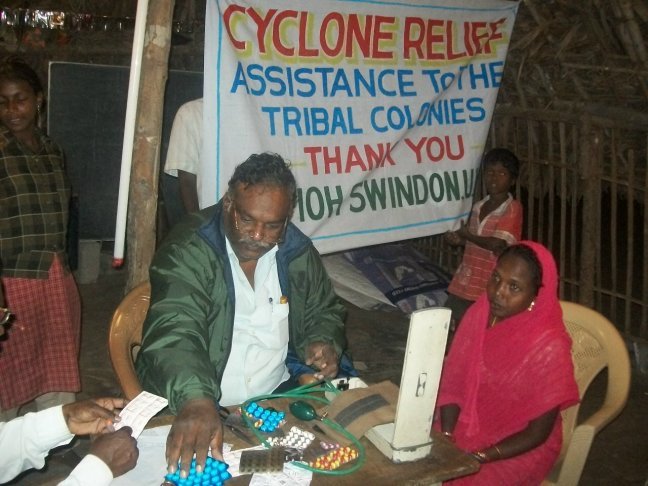
 The FIOH Fund supported a relief programme that was established by HEARTS in November 2013 to help victims of severe cyclones affecting Andhra Pradesh. A major camp was conducted on 22 nd November which benefited 165 children and 74 women in the tribal colonies of Krupa Nagar and Venkata Reddy Nagar.
The beneficiaries received food supplies – rice, Dal, wheat, oil, sugar and kerosene for cooking.
All children received note books and stationary. All the children and adults were examined by a doctor for various illnesses and given medicines. The main problems were fever, cold, cough, body pains, skin allergy and leanness.
There were three cyclones in this month namely Phi-leen, Helen and Lehar. Hundreds of families were evacuated and a large number of cattle and poultry were killed. All schools and offices were closed for two days. HEARTS supported the most needy and neglected people in Bapatla tribal colonies. The people here are absolutely poor and don’t even come to town for work. Blankets, childrens clothing and a temporary roof for the school was also provided.

If you would like to support the work of the FIOH Fund please make a DONATION:


Tsunami relief programme in Andhra Pradesh – December 2004
 Background
The tsunami of December 26, 2004 killed over 150,000 people in a number of Asian countries and millions were made homeless. The economic cost of the destruction was staggering. Unlike the Pacific Ocean, tsunamis may happen only once or twice in a century in the Indian Ocean. Tsunamies occurred in 1941 and 1881 and originated from earthquakes off the coast of Sumatra and around the nearby Andaman and Nicobar islands. The tsunami of 1945 struck India’s West Coast and was generated by an earthquake off the coast of Mekhran in present day Pakistan. Although that earthquake was much less powerful than the one of December 26, 2004, the geological structures in the Mekhran area are capable of setting off more powerful and hence more dangerous earthquakes and tsunamis, say experts.
The Tsunami hit hours after an earthquake off the Indonesian Island of Sumatra at 6.28 am IST on 26/12/04. The Andaman & Nicobar Islands (India) experienced 8 aftershocks ranging from 6 to 5.8 on the Richter scale.
The FIOH Fund response
The FIOH Fund was able to make a small contribution to this disaster through its partner HEARTS based in Guntur, Andhra Pradesh, where the tsunami had devastating affects. The coast of Orissa and Tamil Naduc were also badly affected.
HEARTS director reported:
“We have visited the three camps in Bapatla and neighboring towns Nizampatnam, Vetapalem and helped with supplies and liaising with local government for further help for the loss of boats, fishing nets and compensation. We had a meeting with the District Collector and Revenue officers and they have assured that help would be provided. We were able to get medicines from the local pharmacy stores and doctors assured help at any time. The children needed long term help in addition to the government’s compensation to parents – they were using it for personal items or towards building a house. The children needed help with schoolbooks and clothing. The death toll rose to 17,500 in India – 8,000 in Tamil Nadu and 175 in Andhra Pradesh (27/1/2005).”
HEARTS continued help during the first few months of 2005.
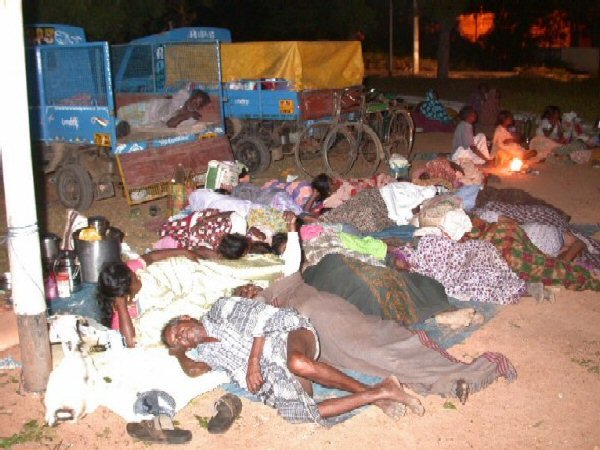
Hearts worked with local NGOs and supporters with the relief work in these areas. The photographs below of the devastation were taken in the initial days of the situation in Tamil Nadu and Andhra Pradesh states.
Financial Assistance:
Hearts received Rs.116,887 (£1,670) from friends groups in the UK and Australia for relief work. Local donations were received in kind such as blankets, cooking utensils, clothing and some food supplies.
Relief Camps for children:
6 relief camps were conducted in two districts. In these camps an average 25 -30 children received regular support for food and games, counseling, non-formal education etc.
Hearts identified 12 children who lost single or both parents due to Tsunami. These children were looked after by HEARTS since they had no other support from their families/relatives. The community response was very saddening. The people are in big shock and fear. They refuse to go back to sea for 3 months although the Government tooksteps for them to get back to normality.




Some statistics on the tsunami:
THE DEATH TOLL
 India 9,682 (official figure)
Tamil Nadu Dead: 7,921 (Nagapattinam: 6,023; Cuddalore: 606) Pondicherry Dead: 579 Missing: 86 ; Kerala Dead: 170 (Kollam: 130; Allappuzha: 35); Andhra Pradesh Dead: 105 Missing: 11 (Nellore: 20; Guntur: 12); Andaman & Nicobar Dead: 900 Missing: 6,010 (Car Nicobar: 336; Great Nicobar: 102)
FINANCIAL LOSS (INDIA)
The centre puts the preliminary estimate of the total loss for Tamil Nadu, Andhra Pradesh, Kerala and Pondicherry at: Rs 5,322 crore
Statewise losses:
Tamil Nadu: Rs 2,730 crore
Andhra Pradesh: Rs 720 crore
Kerala: Rs 1,358 crore
Pondicherry: Rs 512 crore
Andaman & Nicobar: Rs 2,500 crore.
Other countries death toll:
Indonesia 94,081; Sri Lanka 30,500; Thailand 5,200; Maldives 82; Malaysia 68; Burma 64; Somalia 300; Tanzania 10.
If you would like to support the work of the FIOH Fund please make a DONATION
Health, Education, Awareness, Rehabilitation and Treatment Society, India
 Background

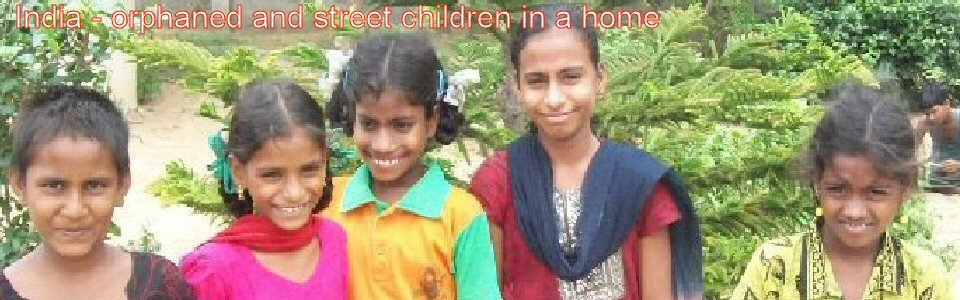
HEARTS is an indigenous registered charitable organisation established by a group of committed citizens from various fields with a strong desire to uplift abandoned, runaway and destitute children.
Despite the UN Convention on Child Rights and various policies of member countries and their Acts, the problem of street children looms large, worsening day by day. Street children congregate mostly at railway stations and bus terminals where they have a place of shelter and can beg for their livelihood. Also children prefer railway stations where free travel is possible.
Railway platform children in India have made railway stations their home, a place of living, eating and sleeping.
They live in a situation where there is no protection, supervision or direction from responsible adults. The main reasons these children leave their homes include poverty, lack of love, alcoholic parents and family disputes.
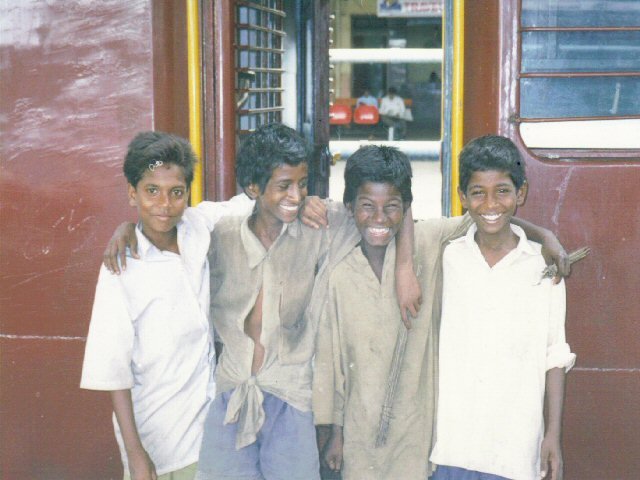
The main problems they face as street children are lack of food, shelter, harassment from antisocial elements, police, drug abuse, etc. Hence it is essential to rescue these children who are in the utmost danger. They have no access to education and information to help them grow as normal, healthy and happy children. Begging is their first occupation for survival. In addition to struggling for food, street children are not bothered about dress, health care, washing, bathing, etc. Because of their lifestyle they have a very poor health condition. There is no one to care for them in times of emergency or illness. They have no savings to pay for medicines and doctors fees. When injured they leave wounds unattended. Thus they learn to live with diseases.
Children who left home for relief might in fact face abuse, harassment, exploitation and deprivation. They often undergo oppression from officials or older boys and their behaviour often becomes submissive. With such abnormal situations their lives are slowly destroyed.
The experience of this boy, Tangavelue, illustrates the severe problems that street children face. This boy was beaten by a ticket collector when he tried to enter a train carriage. HEARTS director, Mohan Rao made a complaint to the station inspector and sought to trace the offending person.
The next day a sub-inspector from the Railway Police brought 11 children to HEARTS requesting that they be taken care of by the organisation. HEARTS is now working in close association with this official to help children who arrive at Guntur station.
Objectives
- To reach out to street children found begging and living on the railway stations in and around Guntur City, Andhra Pradesh
- To provide need based services for their growth and development.
- To offer facilities for literacy, numeracy and life education.
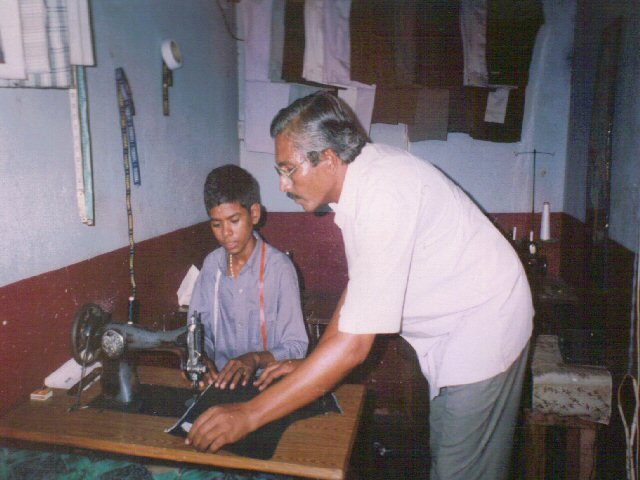
- To arrange facilities for vocational training for better living.
- To improve the children’s self respect, self confidence, voting opportunities and dignity through the provision of love, care, concern and friendship.
- Health care
- Nutrition
- Formal and non-formal education
- Vocational training
- Counselling
- Recreation
- Outings and camps
- Referral services
- Services for saving
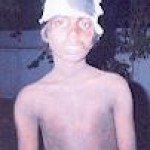 A terrible accident occured at midnight on 23rd September 2002 in Guntur railway station. Chandu, a 12 year old boy, fell from a moving train and lost his right hand and seriously damaged his right leg. He was taken to hospital by some of the other street children and HEARTS staff were informed of the accident. HEARTS immediately took steps to arrange blood and medicines for him.
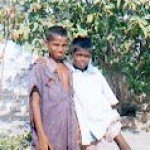
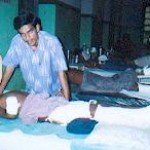 He was operated on and put in plasters for several days. His mother was then called to stay with him. He is seen here with HEARTS director, Mohan Rao Dasari.
Initially HEARTS operated from lock-up garages situated near the Guntur railway station, but now has a home for street children and orphans with better facilities for education and accommodation.

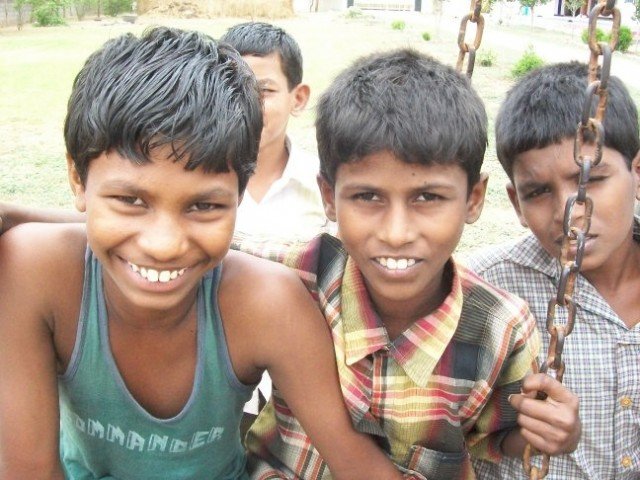
HEARTS has also assisted with:
Tsunami relief in Andhra Pradesh in December 2004
Cyclone relief in Andhra Pradesh in November 2013

New Hope Rural Leprosy Trust
 Background

Probably the best way of introducing the work of New Hope is to recount some of the early experiences of the founder of the Trust, Eliazar Rose, in the introduction to his book “The Ring of Capital L”:
 I was in a leprosy colony taking skin biopsies when one day a woman came in and sat on the broken step of the small temple which a local businessman had built. He had in fact encroached on a piece of Government land allocated to the colony.
The land was barren and stony – wasteland except for one corner of approximately one acre. That piece was almost prime rice land as it had a small spring fed irrigation canal at one point. The businessman owned the adjoining land and simply encroached on the piece that would at least have given the patients a few bags of rice. The temple was an appeasement to the colony to get them to back off with their constant appeal to the local government land revenue officer. The temple of course was built with sun baked mud bricks bonded with a mortar with very little cement. The building, not surprisingly, started crumbling with the first monsoon rains.
Jokingly I told her not to sit on the cracked step as the wall behind her might collapse and fall on her. She asked if that happened would she be killed?
I didn’t answer.
Her story was simple. She had leprosy for many years, taken treatment and stayed in her home because her husband was the village leader. He believed it was his responsibility to care for her against the social norms of the time.
He died and the village turned her out with the threat that, if she didn’t go, they would burn her house down.
She left alone and her married family stayed behind in the village.
In the same colony a year later a woman came in while we were distributing rations. It was mid summer and simply too hot for the old people to go begging. This was long before we started a programme of custodial care by having people sponsor the aged.
At the end of the long queue an argument started. I stopped helping the two paramedics weighing out rice to see what had happened.
The argument was about this woman who had been in the colony for a couple of weeks and was not on our register. The elders of the colony had said that she couldn’t get a ration because they feared that one extra would mean a fraction less for them.
Life in a leprosy colony is tough – Life in India for the poor is tough.
She argued that she had a piece of paper like them. Everyone had been issued with a ration medical card. She did have a piece of paper. It was a hand-written notice certifying that her husband had divorced her because she had contracted leprosy.
In the same year I watched from a small first aid post we had constructed in a colony as a bullock cart wandered slowly down the dusty track in the middle of the afternoon. The wind was hot and it had been a long day dressing ulcers. I wasn’t really in a good mood.
The cart creaked to a halt and a woman slipped off the back and squatted on the ground. Three men climbed down and came over. They announced they had decided to send her away as she had leprosy. They of course said they were doing a kind deed bringing her to a colony instead of simply sending her away with nothing.
One man was her husband, another was her eldest son and the third was from the lowest caste in the village. It had been his job to help her climb onto the cart.
They nodded when I asked if the ‘well conditioned bullocks and cart were theirs. They smiled with pride.
Something cracked inside me. I had the colony men drive the three of them out of the colony without their bullocks and cart.
They went to the local police station and tried to register a case. A lone constable came to the colony, or should I say as near as he dared; to the path leading to the colony. I told him that indeed the colony did have a cart and two good bullocks and that two men had come into the colony and tried to steal them. Did he want to come into the colony and verify it all?
The police inspector saw me in town that night and stopped me. We made a deal that the cart and bullocks should be sold within three days and that I should report that there were certainly no bullocks or cart in the colony.
The proceeds built the outcast woman a small mud-walled hut with a grass roof. Majji lived there in the colony for almost twelve years. She died in 1996.
I don’t know how often she smiled, but whenever I visited the colony she would nod and smile as I passed her hut.
It was during this time that I was employed to visit 13 leprosy colonies to see more than 2,500 patients on a monthly basis. Things seemed to happen when I was in the colony. I know these experiences have influenced the policy of our Trust to adopt an ‘open door’ approach.
One cold winter’s morning I cycled from the town where I stayed to five surrounding leprosy colonies.
The turn into one colony was at a junction on the highway. There was a tea shop on the corner where I went each month. The owner asked me where it was that I went when I visited. I told him ‘To the leprosy colony down the road’. He did not smile.
After that, whenever I stopped he would take a cup down from the top shelf and wash it out with hot water before pouring my tea. When I had finished he would pour hot water over the cup and place it back on the top of the cupboard.
The fear associated with leprosy is not something that is described in words, but rather by the actions, of others.
One month later I arrived at Jigabur leprosy colony. I was late because the monsoon rains had caused a river to flood. Thirteen houses in a small colony on the bank had been washed away when an embankment upstream had broken.
We got no sympathy from the local government flood relief officer. He considered it a blessing that the houses and people had been washed away in the night as it meant they were no longer ‘polluting the river’.
I didn’t know what to say when a new patient appeared before me for an ulcer dressing. I asked her name. She began to cry. She had been warned by her family never to mention her name even when they forced her to leave their home and village.
She showed me a two rupee note her husband had given to her. He gave it to her with the advice that the best thing she could do with the money was to buy rat poison for herself.
I am not very fond of speaking at service clubs in India. I have the feeling they are out of touch with the social fabric of our society. A few times I have not been able to come up with excuses quickly enough and have felt obliged to attend.
At one such meeting (it certainly wasn’t at a Rotary Club), a member asked if I could please visit his home the next day. I knew by the way he spoke there was ‘leprosy in the house’.
His brother’s wife was in what I will simply describe as border line leprosy trauma. She was pregnant with her third child. The husband was a lawyer and the brother, incredibly as it seems, was a doctor.
Money was not the problem. Their request was simple – could I find a place in one of ‘those places’ where ‘they’ lived and build her a ‘nice place’. The end of this story is too sad for me to write about, even after 15 years.
It is my belief that if we can change the attitude of people in India towards this now curable disease, we can make other social changes.
If we can change the attitude to a disease whose name strikes terror just by its utterance, then getting other social changes will be easy. This policy, this belief, is happening in areas where we work.
Nowadays we see fewer and fewer people being turned away from their families, their homes and their villages because of the stigma associated with leprosy.
Some people allege that young people become leprosy paramedics simply because they can’t get a job elsewhere, or because it pays reasonably well (at least today it does).
I disagree, because you need to have a heart in the right place, you have to have a depth of compassion and courage, to write LEPROSY PARAMEDICAL on papers, that goes far beyond the negative comments that some people still make.
Although New Hope was established originally to help those suffering from leprosy, its work has expanded to include tribal people in general, street children and victims of ‘natural’ disasters.
Since its foundation New Hope has carried out health inspections on over one million people in western Orissa. Over 6,000 people have been identified with leprosy and most have received treatment. Over 5,000 have been cured.
In addition to the hospital, the only one of its kind in western Orissa, the Centre accommodates:-
· a hostel for children with physical and mental disabilities (mainly polio) –
· calliper and shoe making units
· administrative block, and staff and patient accommodation
· accommodation for visitors, surgeons and students
· a weaving unit
· a shop for the use of patients
· laboratory
· vegetable gardens for patients
· occupational therapy unit
· savings and credit facility
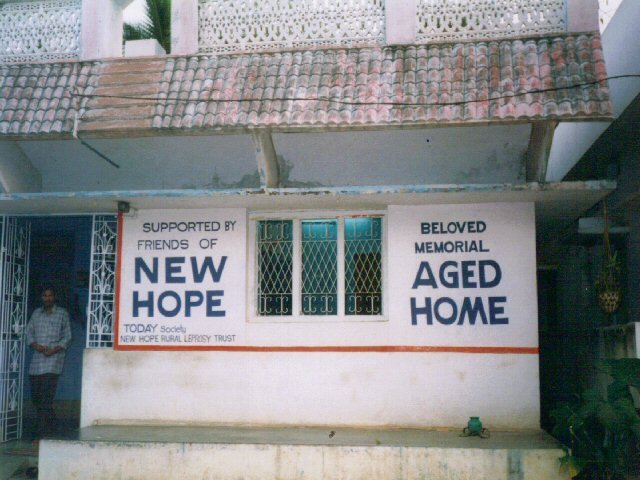
New Hope also has homes for old people, disabled children and for street children.



Leprosy Colonies
In the leprosy colonies it serves, New Hope treats 2,500 patients on a monthly basis and has extended its work to the 76 villages of a remote hilly and forested tribal area named Raghubari.
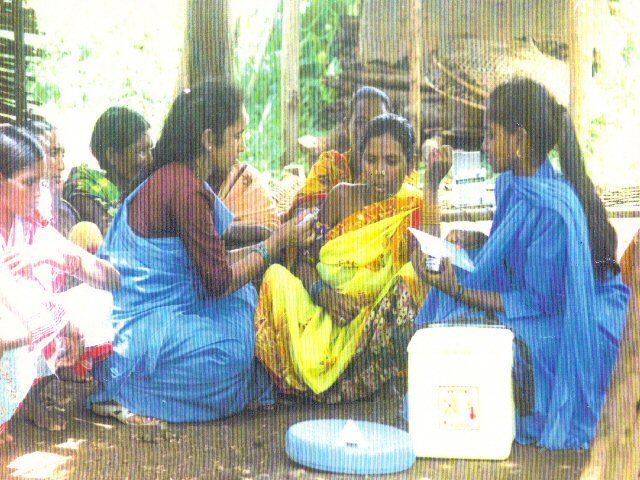
In all its areas of operation New Hope provides anti-tetanus and polio immunisation, iron and folic acid supplements and safe delivery kits for pregnant women.
Street children
Street children are a manifestation of societal malfunctioning and an economic and social order that does not take timely preventive action. Today, street children command a great deal of attention because of their sheer numbers and high visibility. Street children are found in large numbers in all Indian cities. They are forced onto the streets because they cannot cope with their family situation. A street child is forced to be an adult at an early age. He/she has to struggle for survival and earn an income for day-to-day living. By running away from their families, these children are making a major decision and even displaying their anger towards their irresponsible parents.
The need for systematically observing and deeply understanding the behaviour of street children must be emphasized. These children are not substandard ignorant kids. They have acquired the valuable knowledge, attitudes, emotions, abilities and skills that are necessary for their survival on the street. Though self-esteem is the answer to all childhood problems, street children have a weakly developed identity. This identity is derived from their interactions with their peers on the street and with adults who often abuse or deceive them, instilling in them fear or rejection.

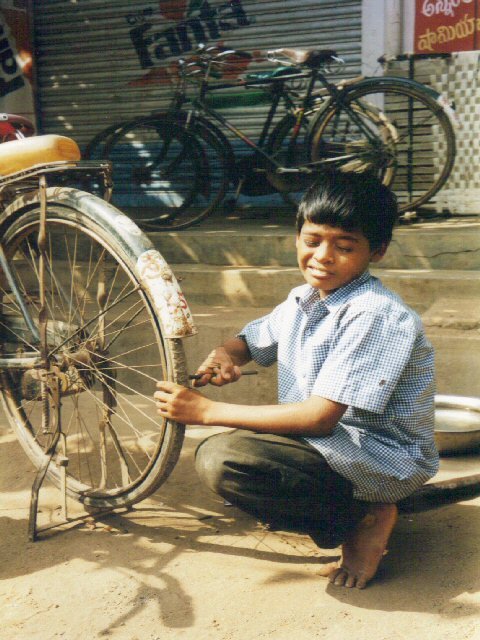

Although each child has a different story to tell, most of them have irresponsible parents and experience poverty and marginalisation. Parents are models, whether they want it or not. It is in the give and take of the parent-child and other relationships that the child finds a sense of security and self-esteem and the ability to deal with complex inner problems. But in the context of street children, the parents’ behaviour is often so cruel that the child makes a heroic decision to walk out on them into urban uncertainty. Poverty often overwhelms and infuriates the child rummaging through a garbage bin for discarded food. Ironically, food becomes an escape for street children. Their ravenous appetite and the fear of hunger compel them to eat every scrap they can get their hands on. Thus the street children have a combination of different characteristics. In varying proportions they can be emotionally vulnerable, physically resilient, naïve, wary and street-smart.
In spite of the increasing visibility of India’s ‘overall’ development on the international scene, the ‘inner contribution’ has been that the enrichment of a few is accompanied by the marginalisation or exclusion of millions of others. The real issue is that development continues to benefit some people, while many others are left out and pushed out. The phenomenon of street children has its roots not just in what meets the eye (poverty, family problems, etc.) but also in this whole gamut of development itself.
Child labour
Working children are everywhere but invisible, toiling as domestic servants in homes, labouring behind the walls of workshops or hotels or on hidden from view plantations. Millions of children who work as domestic servants and in unpaid household help are especially vulnerable to exploitation and abuse. Millions of others work under horrible circumstances. Child labour is a pervasive problem throughout the world, especially in developing countries. It is prevalent in rural areas where the capacity to enforce minimum age requirements for schooling and work is lacking. Children work for a variety of reasons, the most important being poverty and the induced pressure upon them to escape from this plight. Though children are not well paid, they still serve as major contributors to family income. Working children are the objects of extreme exploitation in terms of toiling for long hours for minimal pay. Their work conditions are especially severe, often not providing the stimulation for proper physical and mental development. Many of these children endure lives of pure deprivation.
Despite restrictions on child labour, children do work. This vulnerable state leaves them prone to exploitation. The International Labour Office reports that children work the longest hours and are the worst paid of all labourers. They endure work conditions which include health hazards and abuse. Employers take advantage of the docility of the children, recognizing that these small ones cannot legally form unions to change their condition. Such manipulation stifles their development. Deprived of the simple joys of childhood, these children are relegated to a life of drudgery.
However, abolishing child labour has its own limitations. First, there is no international agreement defining child labour. Countries not only have different minimum age work restrictions, but also have varying regulations based on the type of labour. This makes the limits of child labour ambiguous. Most would agree that a six-year-old is too young to work, but whether the same can be said about a twelve-year-old is debatable. Until there is global agreement which can isolate cases of child labour, it will be very hard to abolish.
Child labour is a significant problem in India. The major determinate of child labour is poverty. Even though children are paid less than adults, whatever income they earn is of benefit to poor families. Some parents are of the opinion that formal education is not beneficial and hence children learn work skills through labour at a young age. Another determinate is access to education in some areas. Education is not affordable, or is found to be inadequate. With no other alternative, children spend their time working.
Child labour can’t be eliminated by focusing on one determinant, be it education or brute enforcement of child labour laws. National and state Government must ensure that the needs of the poor are fulfilled before attacking child labour. If poverty is addressed, the need for child labour will automatically diminish. Children are growing up illiterate because they have been working and not attending school. A cycle of poverty is formed and the need for child labour is reborn after every generation.
If you would like to support the work of the New Hope Rural Leprosy Trust this can be done through its sister organisation in the UK: The New Hope Rural Community Trust.
