
FIOH Sierra Leone – responding to climate change and Covid 19
ACTIVITY REPORT
PROJECT : Local response to climate change and Covid19
Funder : FIOH Fund -UK
COST : GBP 545
REPORTING DATE: 4thJune 2020
Brief background
In a bid to integrate climate change in development projects, FIOH-SL in collaboration with FIOH-UK supported farmers to mitigate climate change through scaling up the adoption of regenerative agriculture. This involved farming practices that work together not just to sustain, but to increase the carrying capacity of the land, restoring the natural fertility of agro-ecosystems. Core practise involves permanent soil cover with living plants, minimum or zero tillage, maximization of biodiversity, composting from zero waste in the farming system and reduction of agrochemicals with a view of their elimination.
FIELD ACTIVITY RESULT
Result of activity 1: Organize community sensitization meetings on climate change:
- Two community sensitization meetings were organized which attracted 50 participants, farmers, stakeholders, facilitator and participants to share learning on the following:
WHAT IS CLIMATE CHANGE?
Following the discussion on the literal understanding of climate change, participants also brainstorm, on the kinds of climate hazards.
- Heavy wind
- Increase in the frequency and magnitude of warm daily temperature (extremes and decreases)/prolong day seasons from October May)
- Frequency heavy precipitation/rainfall.
- Spring/small rivers completely dry up during the day season.
IMPACTS OF CLIMATE CHANGE
- Water shortage
- Floods
- Heat waves
- Droughts
- Outbreak of infectious diseases.
Traditional/cultural practices adopted in the past to mitigate climate change as:
- Establishment of fire belts around forest reserves in March.
- No bush clearing around water catchment areas.
- Secret society bushes as protected as forest reserves.
- Forest reserves known as village green surrounding the entrance of villages protected.
- Bush fallowing for 15 years to encourage regrowth.
RESULTS OF ACTIVITY 2 – Practical training on Agroecological/ farming.
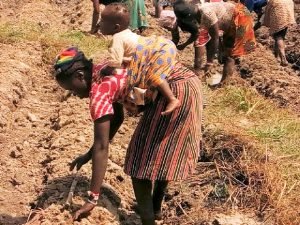
25 farmers (15F,10M) received practical training (5 per session) of farm design, planting methods, plant spacing, zero or minimum tillage practice, composting from zero waste and field application. Monitoring results reveal that farmers are gradually adopting these practices on their own farms.

RESULTS OF ACTIVITY 3 – Seeds and tools support. Following the procurement of assorted seeds and tools, these items were distributed to farmer field school representatives.
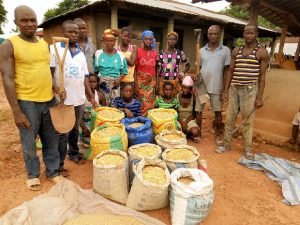


FIOH-SL seeds and tools support to cross-section of farmers.
RESULTS OF ACTIVITY 4 – Seed multiplication and demonstration farms.
Two multiplication and demonstration farms were established in two communities using permaculture/agroecological principles – farmers working with natural forces or farming using natural approaches, the wind the sun and water to provide food, shelter, and everything else including compost, farm/ gardens needs beside seeds and plants. Any farm established using these principles is a permaculture /agroecological farm.

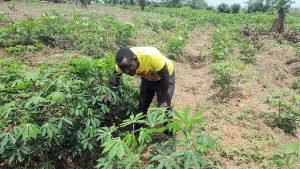
FIOH -SL support to the establishment of two permaculture farms.
CHALLENGES
- Overwhelming demand for the project activities by other FIOH operational communities in Tonkolili and Koinadugu districts.
- Frequent lockdown caused by Covid19 is affecting farm management.
- Lack of on farm hand washing stations to prevent Covid19.
- Farm work rationed with a batch of 5 Farmers per day as a result of Covid19.
WAYS OF OVERCOMING CHALLENGES
- Overwhelming demands
Representatives from the demanding villages were included in the on-farm training and promised to be given some proceeds from the established multiplication farms as starter seeds to establish their own farms. Development of community pilot projects by FIOH-SL is underway to service other communities.
- FREQUENT LOCK DOWN CAUSED BY COVID 19
A detailed concept Note will be shared with National and International donors for possible support.
LESSONS LEARNT.
Household food insecurity exacerbated by the global lock down by Covid19 reveal the extent that existing food systems (and the people underlying them) have been undervalued and under-protected.
Please support the work of the Future in Our Hands Education and Development Fund whose aim is to help and empower some of the world’s poorest and most marginalised people by:
- UK residents can provide long term support by completing the FIOH FUND DONATION FORM and sending to the address shown on the form:
- Direct grant to the charity’s bank account or by cheque to:
 Bank account details:
Co-operative Bank
IBAN: GB07CPBK08929965050707
BIC: CPBKGB22
Cheques should be made payable to the
Future in Our Hands E&D Fund
—————————————————————————-
Fundraising to help the work of the charities would be greatly appreciated
Global warming – the tipping point
The world is now entering a critical era in which a tipping point could arise beyond which human beings will lose the ability to stop runaway global warming.
What are the feedback processes that cause accelerated warming?
First it is necessary to understand that the build up of greenhouse gases can create feedback mechanisms – some with warming and others with cooling – effects. The important point to bear in mind is that the warming effects outweigh the cooling ones. As the quantity of greenhouse gases builds up in the atmosphere this causes effects that increase the warming. The warming itself causes effects which increasethe warming still further. The main effects are summarised below:
Rising CO2 will cause acidification in the oceans killing
plankton which sequesters carbon dioxide thus increasing CO2
concentration in the atmosphere.
Vast stores of methane (a greenhouse gas 24 times more potent than CO2) are trapped or ‘frozen’ in crystal lattice form in sea bed deposits. Rising temperatures in the oceans would release methane into the atmosphere. Methane will gradually break down into CO2 and water vapour, but CO2 has an atmospheric life measured in centuries or even millennia.
Methane is also trapped in large expanses of frozen tundra and this would be released with thawing.
As temperatures rise, the concentration of water vapour in the atmosphere rises. Water vapour is itself a very powerful
greenhouse gas. So this is also a strong and rapid feedback
process.
Increased water vapour would also cause cloud formations that have both warming and cooling effects, the overall impact of
which is uncertain. However, warmer cloud systems would
increase the energy and impact of storm events.
The effect of melting ice would be to replace a white shiny
surface which reflects heat back into space with a dark surface
absorbing heat.
Human activities, including deforestation, present farming practices which break down soil carbon and convert it to CO2 and involve large amounts of fossil fuels, industrial processes and transport using fossil fuels, have already raised the carbon dioxide concentration in the atmosphere above the level which scientists believe will cause catastrophic climate changes. This is above the level that would make a 2˚C temperature rise causing such changes, inevitable. The recorded level of CO2e (carbon dioxide equivalent) in 2006 has been measured at 420 ppm and the rate of accumulation (now at 2 ppm per year) is
accelerating. Hence the feedback dynamics outlined above indicate that not only is it an urgent necessity to stop the use of fossil fuels, but also to adopt measures that would remove CO2 from the atmosphere.
