
ZimConserve, a registered Zimbabwean charity founded in 2012, runs conservation and sustainable-livelihoods programmes from their Resource Centre in Seke Rural District, Mashonaland East. Their work is congruent with Future in Our Hands’ long-standing commitment to environmental and development education, and our work supporting grassroots tree-planting initiatives across West and Central Africa,

Resource Centre, Seke Rural District, Mashonaland East, Zimbabwe
www.zimconserve.org.zw
Initiative a free community library resource for tree seed
The Seke Seed Library
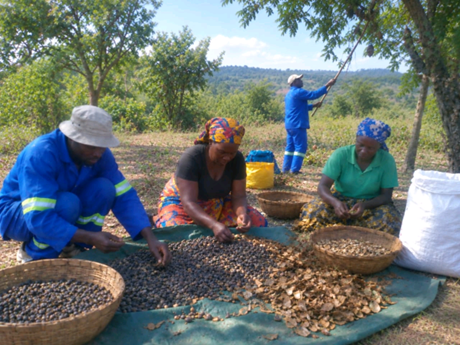
Community members in the initial sorting of tree seeds
Seke has lost significant tree cover to deforestation, land clearing, and unreliable access to good-quality indigenous and agroforestry seed. Opinion surveys reveal that community members want to plant and restore trees but have no local, affordable source of seed and no shared system for saving and multiplying it.
We propose a simple, physical tree seed library at our existing Resource Centre, modelled like a book library, but for seed. Community members would check out starter packets of indigenous and agroforestry tree seed, such as Msasa, Mukwa, Moringa, and various fruit and fodder trees, at no cost. After germination and harvest, growers would return seed collected from their own trees, replenishing and growing the library’s stock season on season. ZimConserve staff, together with a small community committee, would manage simple storage, track loans, and run short seed-collection and tree-nursery trainings. Over two to three seasons, the library would become community-owned and self-sustaining, embedding tree-planting knowledge and habit locally.
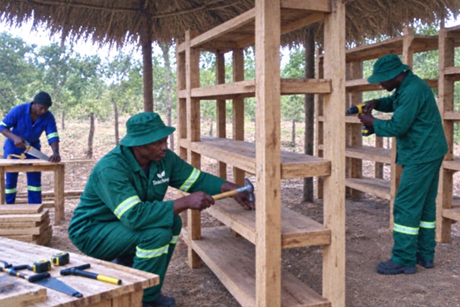
Zimconserve staff have been building the storage shelving that will house the seed library at the Resource Centre, an organised space to keep starter packets ready for community members to check out.
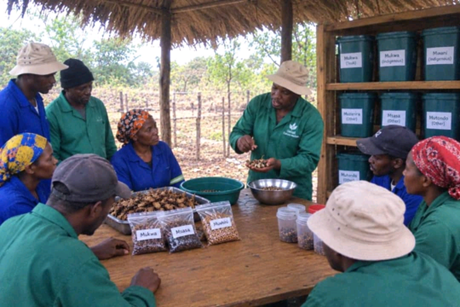
Meticulous storage and labelling of species
Timeline: Seed and materials will be procured, training and the library launch will take place within four weeks; and the first seed loans will be distributed at the start of the next planting season, with returns beginning after the first growing cycle.
Sustainability: The library sits inside ZimConserve’s existing, staffed Resource Centre, so there are no new overheads or staff required, and the return-and-multiply model means the seed stock, and the tree cover it produces, keeps growing after the grant ends.
Beyond seed conservation, the seed library will boost local tree species diversity, support reforestation and agroforestry, and give community members reliable access to quality planting material. We prioritise multipurpose fast-growing trees like Moringa, and plan to also incorporate other multipurpose species such as Leucaena, Calliandra, Gliricidia, and Acacia — all valued for fodder, soil improvement, and fast canopy cover.
Further cooperative initiatives that Zimconserve promotes
– Purposeful Play Project: Prioritising the next generation of farmers.We partner with schools on agroforestry development, and our work was recently featured in the Deutsche Welle Environmental Bulletin (links: https://surl.li/wakbml and https://surl.li/csbtma).
– Bottle Gardens Initiative: Low-cost, climate-resilient growing spaces built from recycled plastic bottles, strengthening food security while cutting plastic waste — a simple idea with real impact, supported by The 1% Fund (https://shorturl.at/5Z84u).
– Farmer Training & Demonstration Centre: We’re seeking funding to construct and fence a 2.1-hectare centre with a central training facility and five demonstration hubs (mushroom, apiculture, horticulture/agroforestry, livestock, and aquaculture).
– NLF Dairy Pilot: With the Natural Livestock Farming Foundation (Netherlands), we’re developing a 12-month pilot in Mashonaland East, training 60 smallholder farmers and 10 veterinarians in the NLF 5-Layer Strategy through a participatory programme covering ethno-veterinary medicine for five key livestock diseases, improved husbandry, strategic breeding, and milk quality practice.
Agroforestry sits at the heart of this project rather than alongside it: indigenous medicinal trees and plants are integral to the ethno-veterinary treatments farmers are trained to use, to the improved husbandry and rangeland practices they adopt, and to the new income streams generated through plant-based remedy production. This makes the project a natural and compelling fit for our agroforestry mission, which is directly advanced through every layer of the NLF approach applied here.